

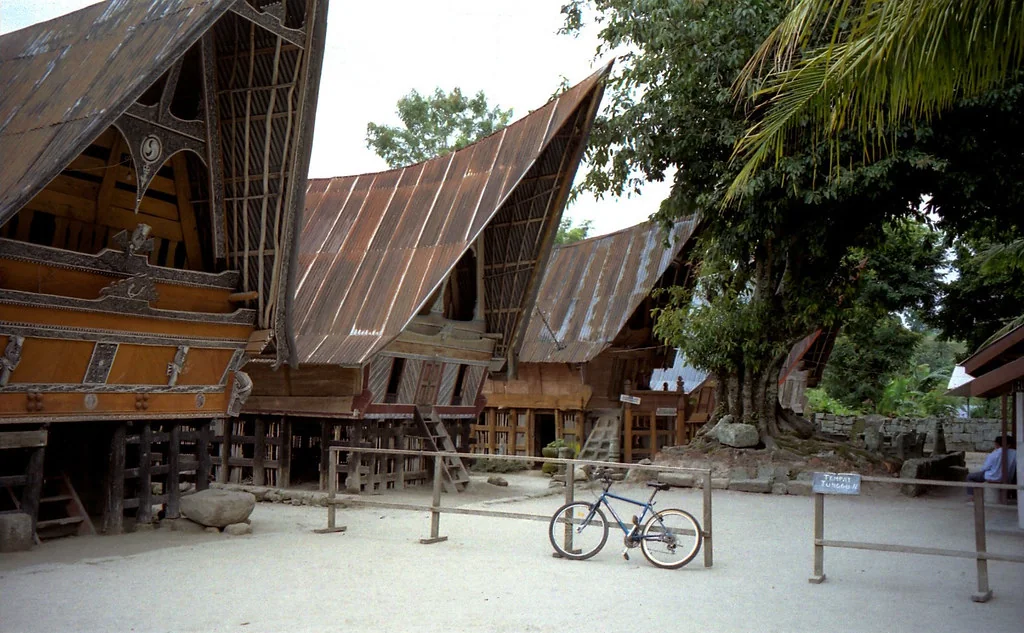
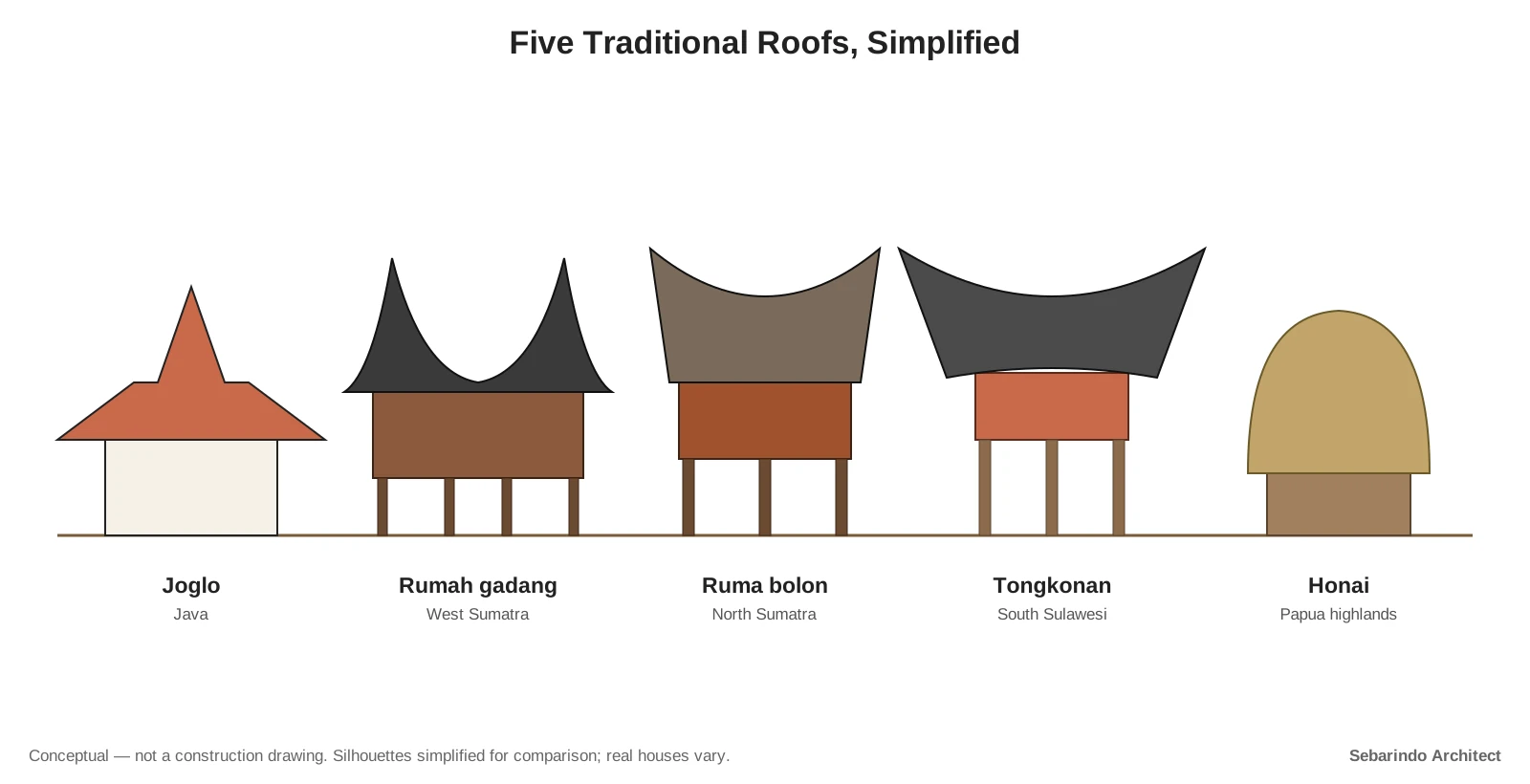
Sebarindo Architect – A common mix-up is to call every traditional Indonesian house simply a rumah adat and stop there. Each one answers its own climate, materials and family life, and the roof is usually the quickest way to tell them apart. This guide covers five of the best-documented, from the cold highlands of Papua to the lakeshores of North Sumatra.
Each summary below draws on published studies or official sources. Houses vary between villages and families, so treat these as introductions, not complete descriptions; checked on October 26, 2026.
Five Houses at a Glance
| House | Region | What to look for |
|---|---|---|
| Joglo | Central Java and Yogyakarta | A stepped roof on four central columns |
| Rumah gadang | West Sumatra | Upswept gonjong roof peaks |
| Ruma bolon | Around Lake Toba, North Sumatra | Carved and painted gorga panels |
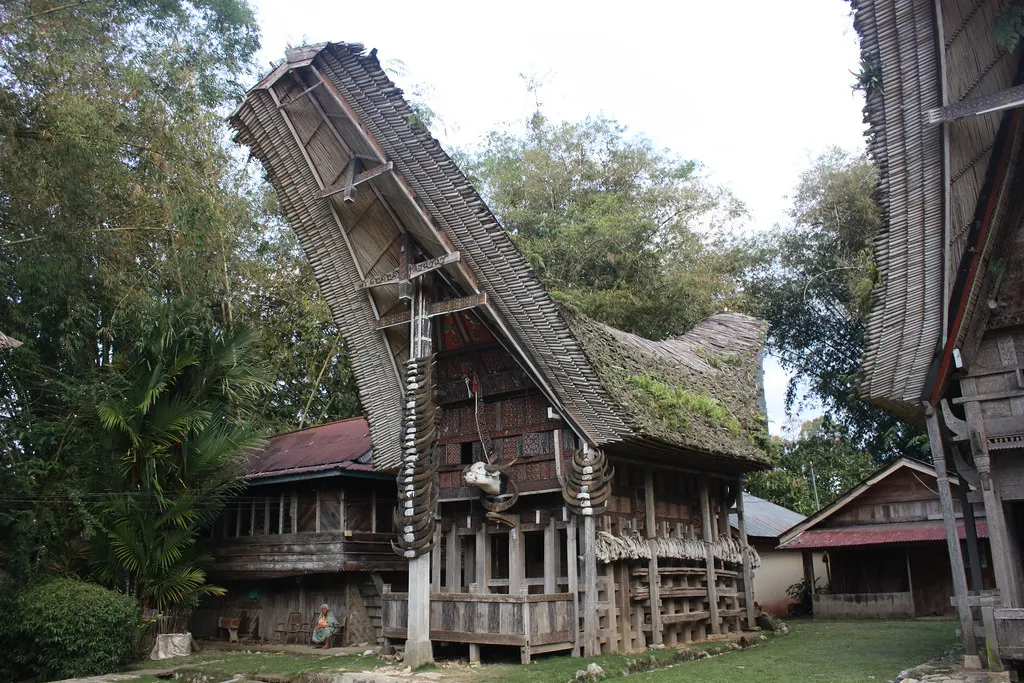
| Tongkonan | Toraja, South Sulawesi | A boat-shaped roof facing north |
| Honai | Baliem Valley, Papua highlands | A round house with a thick thatched dome |
Joglo: Java’s Stepped Roof
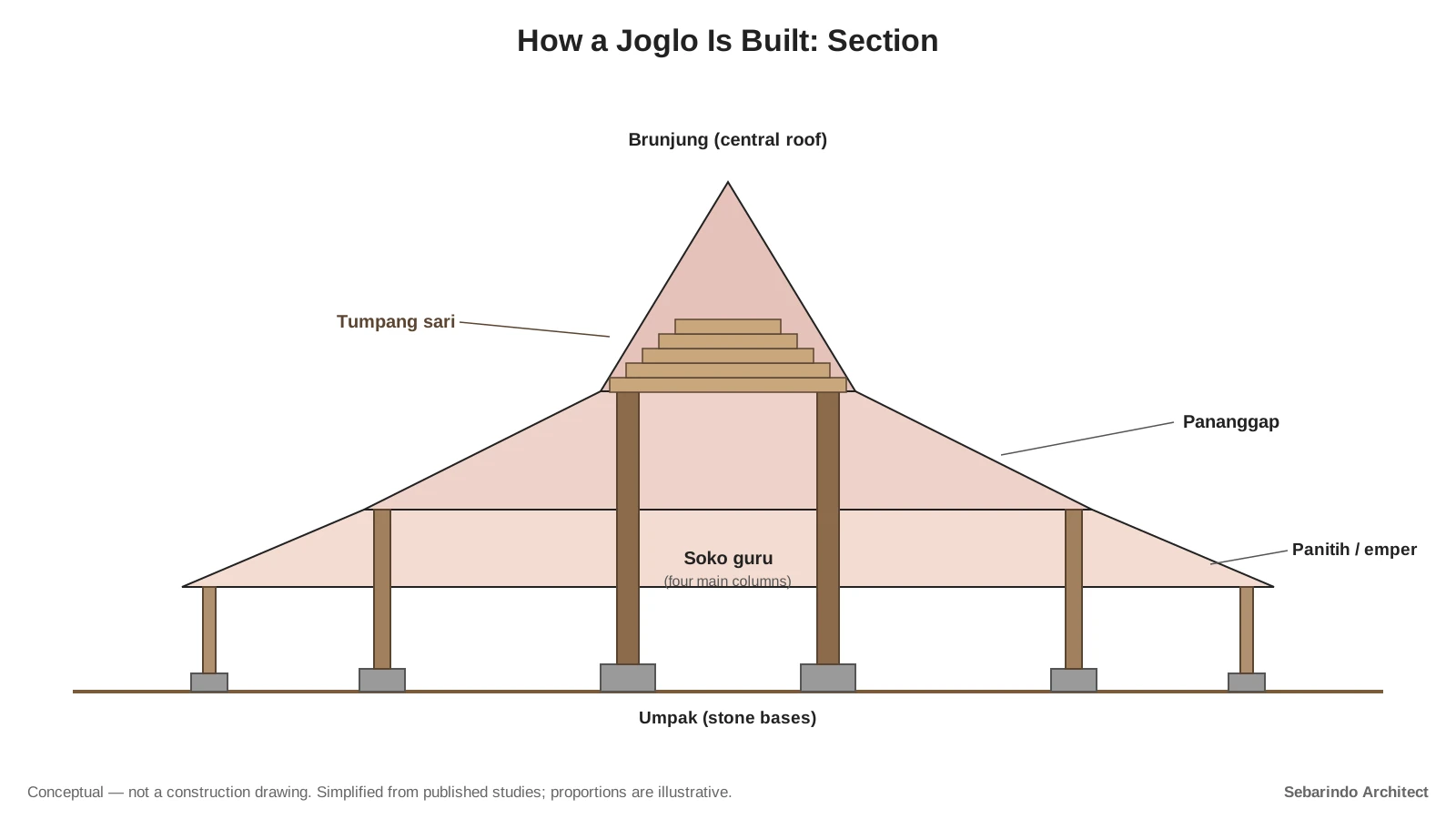
The joglo is one of five basic Javanese house forms. Four main columns called soko guru carry a stack of beams, the tumpang sari, and a roof that rises in steps to a high peak.
Its spaces run from an open front hall, the pendopo, to the private dalem at the back. Our guide to the joglo house explains each part.
Rumah Gadang: West Sumatra’s Horned Roofs
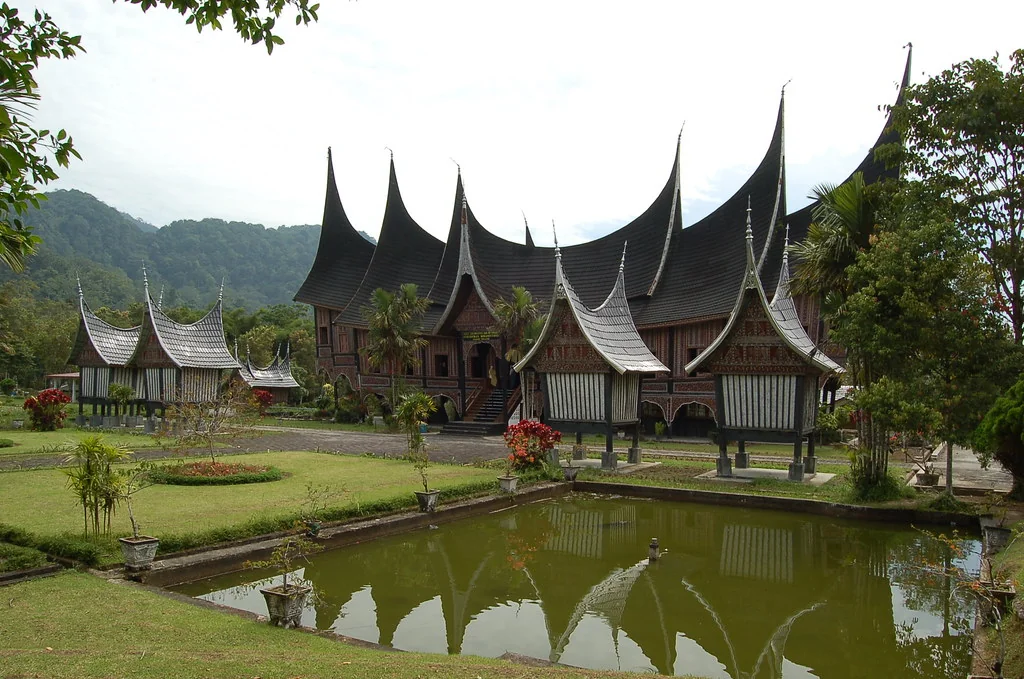
The Minangkabau rumah gadang is a house on posts with roof peaks shaped like buffalo horns. A study links the number of peaks to the number of rows of columns inside.
The house belongs to a matrilineal kin group and is home to related women and their families. More in our rumah gadang guide.
Ruma Bolon: The Batak Great House
Ruma bolon can be translated as “great house,” and it was the residence of traditional Batak kings, according to a 2021 study citing earlier research. It was built from wood, palm fiber and other natural materials.
Its gorga ornaments are painted in three colors: red, white and black. The same study describes the roof, walls and foundation as standing for the upper, middle and lower worlds of Batak belief.
Tongkonan: Toraja’s Boat-Shaped Roof
A tongkonan faces north, and its rooms run in a line from north to south. Its sweeping roof is traditionally made of split bamboo laid in many layers.
Each house is paired with an alang, a smaller rice barn across the yard. It is a family house passed down through generations rather than an individual’s home.
Honai: Warmth in the Papua Highlands
The honai is the traditional house of the Dani people in the Baliem Valley, at about 1,600 to 1,700 m above sea level. Its round plan, low walls and thick thatched roof help keep out cold air and wind.
Inside are two levels: a lower one for daily life and gatherings, and an upper one for sleeping. A hearth on the lower floor warms the room. The name refers to a men’s house; the women’s house is often called ebei.
Shared Traits and Visiting Tips
All five are built mainly from local materials such as timber, bamboo, palm fiber, grass or thatch.
They are also family and community buildings, not just shelters. That is worth remembering when you visit.
Some of these houses are still homes or family centers. Ask before entering, photographing people or touching carved and sacred objects.
Each of these houses took generations to refine. A little time spent learning how they work is a good way to honor that.
Komentar Ditutup! Anda tidak dapat mengirimkan komentar pada artikel ini.