

Sebarindo Architect – “Can you start next week?” is the question many owners ask first, and it is the wrong one. The questions that protect your money are who will design the house, who will build it, what certificates they hold, and how you will pay them.
This guide is for owners hiring an architect and a builder for a private house in Indonesia. It explains the roles, how to check registrations, and what a basic contract should cover; it is general information, not legal advice. Checked on October 26, 2026.
Know Who Does What
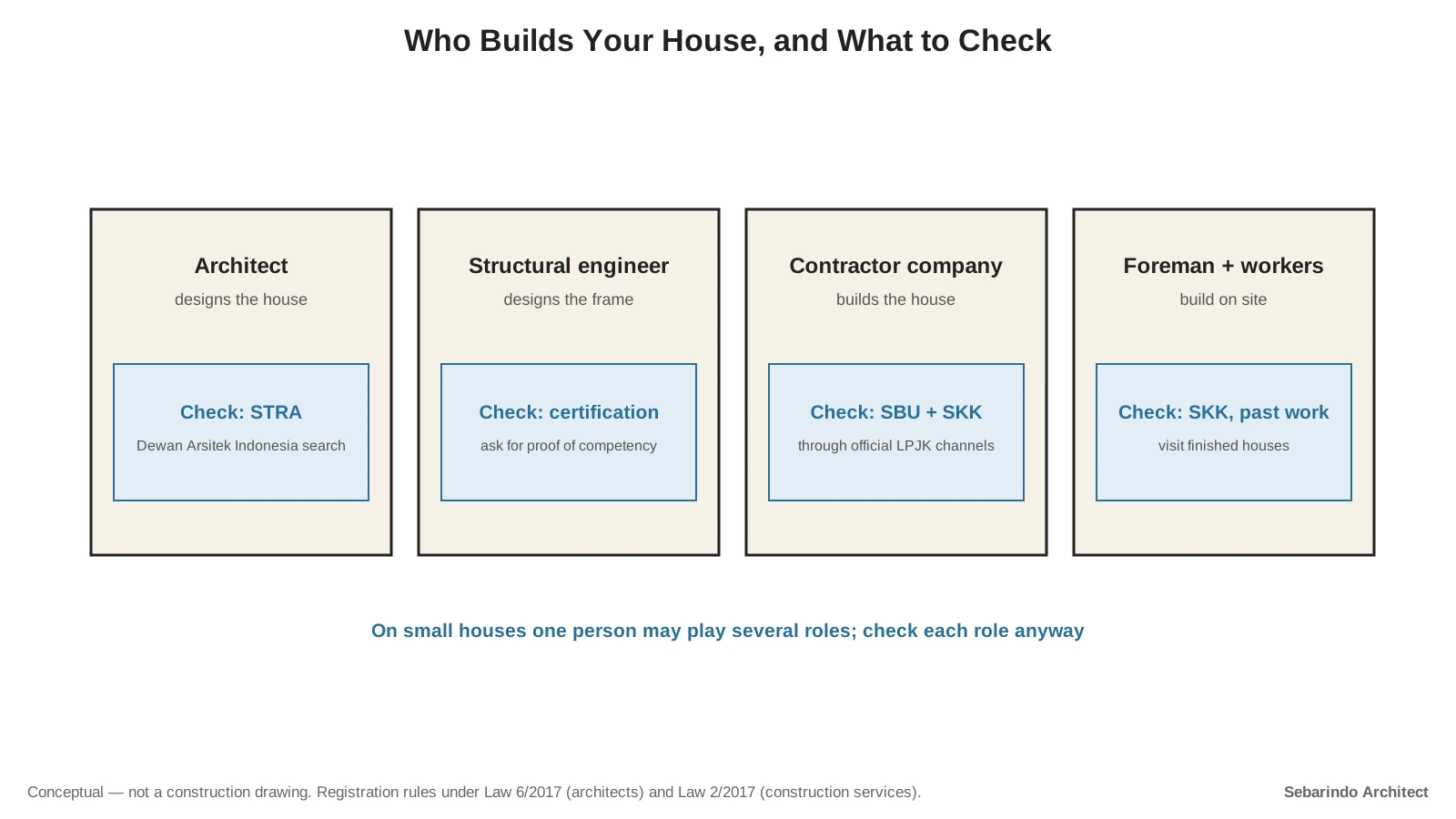
An architect designs the house and prepares the drawings for approval. A structural engineer designs the frame, foundations and other load-bearing parts.
A contractor (kontraktor) builds the house, either as a registered construction company or as a team led by a foreman (mandor) with workers (tukang). On small houses, one person may play several of these roles, which makes checking each role even more important.
Check the Architect’s STRA
Under Law 6/2017 on Architects, holding an STRA (Surat Tanda Registrasi Arsitek), the architect registration certificate, is a requirement to practice as an architect. The Indonesian Architects Council (Dewan Arsitek Indonesia) says the STRA proves professional competence and makes the holder responsible for the safety of buildings they design.
The council’s website has a search tool. Enter the architect’s name and province; if the name appears, they hold an STRA, and if the list is empty, they do not.
Registered architects who break the law can face written warnings, suspension or revocation of the STRA, according to the council.
Check the Contractor’s Certificates
Law 2/2017 on Construction Services requires construction workers to hold an SKK (Sertifikat Kompetensi Kerja), a work competency certificate obtained through testing. Construction companies need an SBU (Sertifikat Badan Usaha), a business certificate processed through the OSS licensing system.
Ask a company for its SBU and the SKK of its site manager, and check them through official channels such as the construction services board, LPJK. A team without any certificates may still be skilled, but you carry more of the risk.
Say two builders quote similar prices. Pick the one who can show certificates and finished houses you can visit and ask the owners about.
Compare Quotes Line by Line
Ask every builder for an RAB (Rencana Anggaran Biaya), an itemized estimate with quantities and unit prices. Without one, you cannot tell which quote leaves work out.
Check that every quote is based on the same drawings and specifications. A cheaper quote with lower-grade cement, thinner reinforcement or fewer finishes is not a cheaper house.
Put It in a Written Contract
A basic contract should name both parties and list the drawings, the RAB, the schedule, and who supplies materials. It should also say what happens when the design changes during construction.
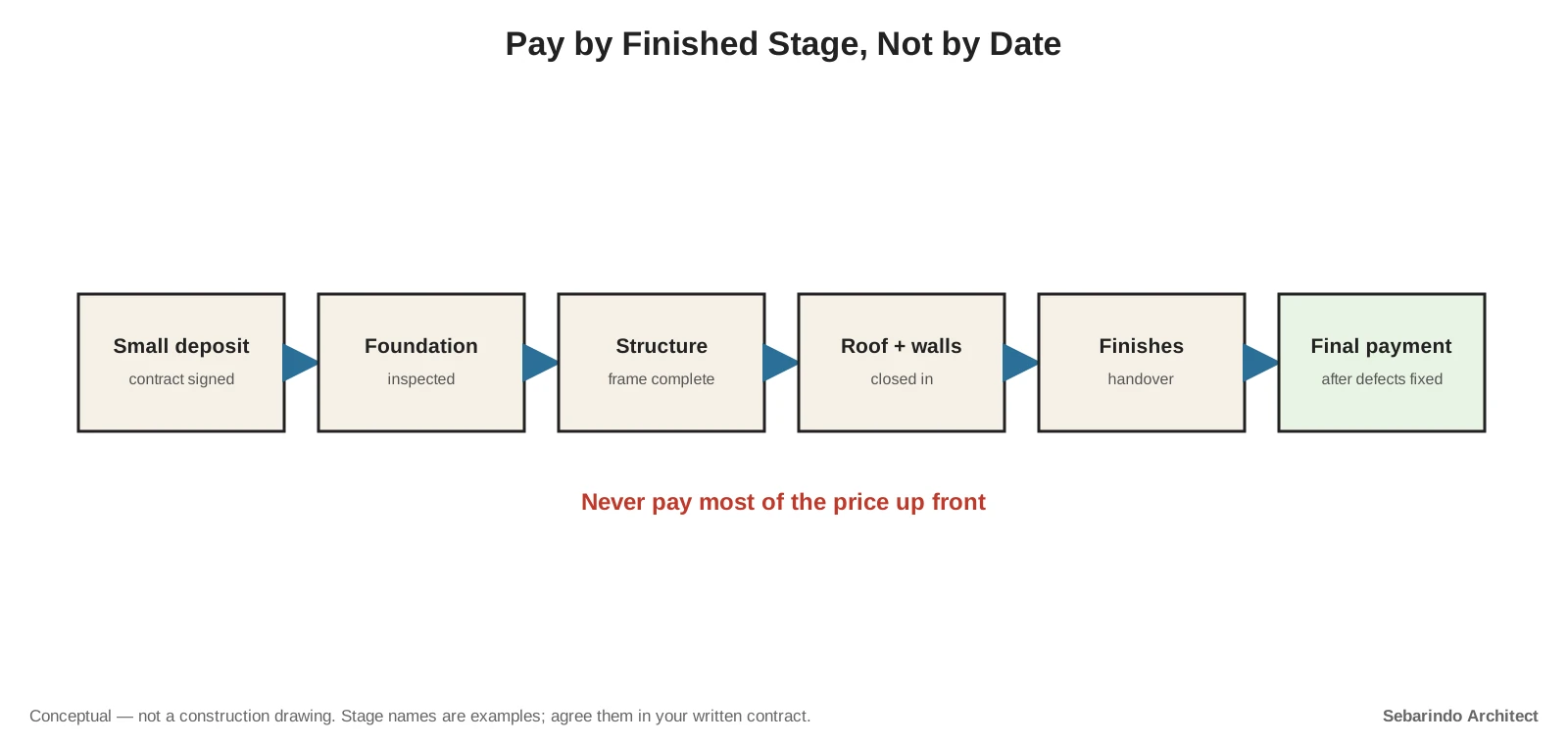
Tie payments to finished stages of work, such as foundation, structure, roof and finishes, not to calendar dates. Keep the final payment until defects are fixed after handover.
Never pay most of the price up front. If a builder disappears early, a large advance is the hardest money to recover.
If the Project Goes Wrong
Keep a site diary with dates, photos and messages. Records make any dispute easier to resolve, whether through talks, mediation or the courts.
Raise problems in writing as soon as you see them. A crack, a wrong window size or missing reinforcement is cheaper to fix the week it happens than after plaster covers it.
For serious structural worries, stop work and ask an independent licensed engineer to inspect before you continue.
Take an extra week to choose your team. It is a small delay against a year of building with people you trust.
This article is general information, not a structural, electrical or legal assessment of your building. Structural work, wiring and permit decisions should be checked by a licensed architect or engineer and your local building office.
Komentar Ditutup! Anda tidak dapat mengirimkan komentar pada artikel ini.