

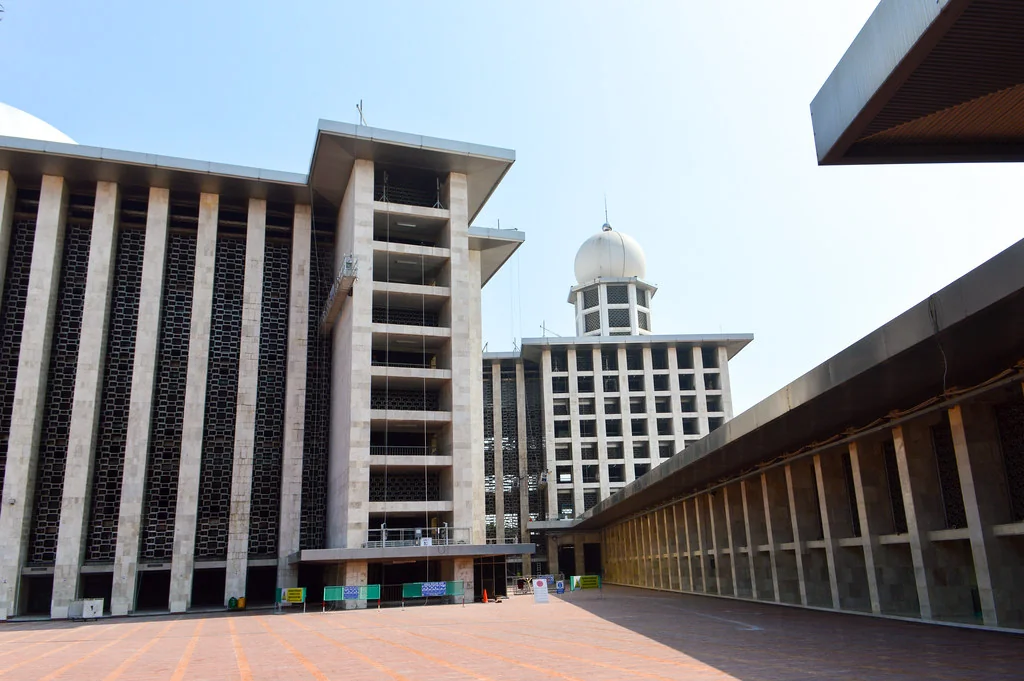
Sebarindo Architect – Say you stand in the courtyard of Istiqlal Mosque at night. Across the road, the twin spires of Jakarta Cathedral rise above the trees, and the two buildings together frame the city’s main square.
This guide looks at the architecture of Istiqlal, Indonesia’s national mosque in Central Jakarta, based on official tourism information and published studies. Visitor arrangements can change, so check with the mosque before you go; checked on October 26, 2026.
A Competition Won by Friedrich Silaban
Istiqlal was designed by Friedrich Silaban, a Toba Batak Christian architect who won the design competition in 1955, according to Indonesia’s Ministry of Tourism. President Soekarno is named as the key figure behind the project.
Construction began on August 24, 1961, and was completed in 1978. The mosque stands on a site of 9.5 hectares and can hold more than 200,000 worshipers.
Modern Lines, Traditional Symbols
A 2018 study describes the mosque as strongly influenced by modern architecture, which Silaban had largely taught himself. It also notes that the dome and tower, elements associated with Middle Eastern mosques, were kept.
The result is a building of plain geometric masses and long colonnades, with a dome and a single minaret marking it as a mosque.
Numbers With Meaning
Several of Istiqlal’s dimensions carry symbolic meaning.
| Element | Size | Meaning given in sources |
|---|---|---|
| Main dome | About 45 m in diameter | 1945, the year of independence |
| Main columns | 12 | The Prophet’s birth on 12 Rabiul Awal, or the 12 months of the Islamic calendar, depending on the source |
| Minaret | 66.66 m for the minaret body (6,666 cm); about 96 m overall in the tourism ministry’s figure | A reference to the Qur’an |
The two minaret figures likely measure different things, so compare like with like if you quote them.
Marble, Plaster and Stainless Steel
A paper by the mosque’s education division and an international university lists the main materials. Inside is marble from Tulungagung in East Java; outside is textured plaster.
The dome is made of lightweight stainless steel, and about 1,800 stainless steel columns support the large roof. Reinforced concrete is also part of the structure.
Facing the Cathedral
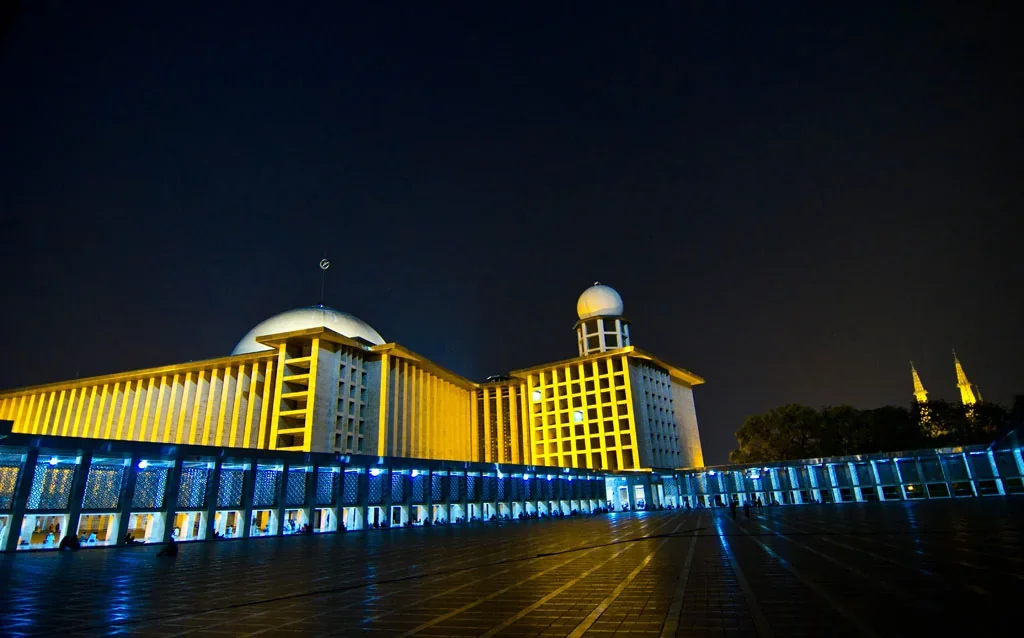
Istiqlal sits directly opposite Jakarta Cathedral, and together they frame Merdeka Square and the National Monument, according to the same paper. The Ministry of Tourism also describes the mosque as next to the cathedral.
Visiting Istiqlal
The Ministry of Tourism lists educational tours led by official guides, covering the mosque’s history and design. It also mentions an exhibition and a library with archives on the construction.
Opening times and dress rules are not given on that page. Check with the mosque’s management before you visit, dress modestly, and avoid prayer times if you are touring rather than praying.
Next time you see the dome, can you count the main columns that hold it up? It is the quickest way to see how Silaban turned numbers into architecture.
Komentar Ditutup! Anda tidak dapat mengirimkan komentar pada artikel ini.