

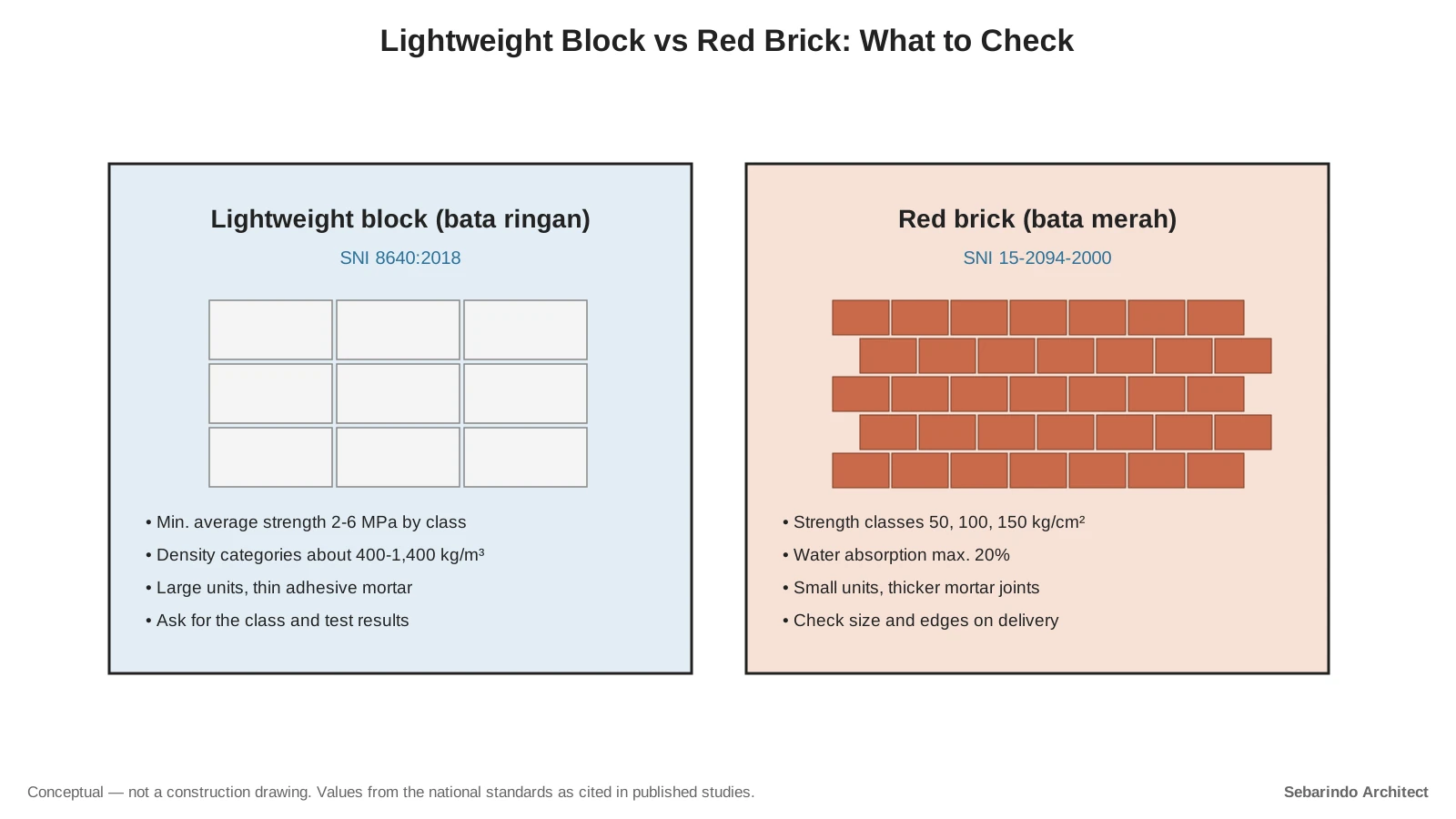
Sebarindo Architect – Should you build your walls with bata ringan (lightweight concrete block) or bata merah (fired red clay brick)? Both can make a good house wall. The better choice depends less on the material’s name and more on whether the product actually meets its national standard.
This guide compares the two for private houses in Indonesia, using the national standards and published test results. Prices and brands vary by region, so they are left out; checked on October 26, 2026.
Two Materials, Two Standards
Lightweight blocks are covered by SNI 8640:2018, the national specification for lightweight blocks used in wall masonry, as cited in a 2026 materials study. Red bricks are covered by SNI 15-2094-2000 for solid red clay bricks used in walls.
Each standard sets minimum strength and other limits. A block or brick that meets its standard is a reasonable wall material; one that does not is a gamble whatever it is called.
Side by Side
| Point | Lightweight block (bata ringan) | Red brick (bata merah) |
|---|---|---|
| Standard | SNI 8640:2018 | SNI 15-2094-2000 |
| Strength in the standard | Minimum average 2 to 6 MPa, depending on class | Classes 50, 100 and 150 kg/cm² |
| Density | Categories from about 400 to 1,400 kg/m³ | Not set as a class in the cited study |
| Water absorption | Varies by product; check the data sheet | Maximum 20% |
| Typical maker | Factories with batch testing | Often small local kilns |
For a rough comparison, 50 kg/cm² is about 4.9 MPa (our estimate). So the lowest red brick class sits within the range of lightweight block classes.
Quality Varies More Than the Label
A 2021 study tested bricks from household kilns in Sidenreng Rappang Regency, South Sulawesi. Their average strength was 42.3 kg/cm², below the lowest class of 50 in the standard.
The same bricks met the 20% water absorption limit but did not match the standard size modules. Uneven sizes mean thicker mortar joints and more plaster to get a flat wall.
Lightweight blocks vary too. A 2026 test of a foam-concrete block made with local sand reached an average density of 800 kg/m³ and strength of 3.23 MPa. Factory products should state their class; ask for it.
Weight, Speed and Finish
Lightweight blocks come in much larger units than red bricks and are light for their size, so a wall needs fewer pieces and fewer joints. They are normally laid with a thin adhesive mortar recommended by the maker, not the thick mortar used for red brick.
Red brick is easy to buy from small suppliers in most towns and familiar to almost every builder. That matters if your contractor’s team has never laid lightweight block before.
Say your site is down a narrow lane. Fewer, larger blocks can mean fewer pieces to carry in, while bricks may be easier to source close by.
Walls in an Earthquake-Prone Country
In houses built with a reinforced concrete frame, walls of either material fill the spaces between columns and beams. The wall material does not replace that frame.
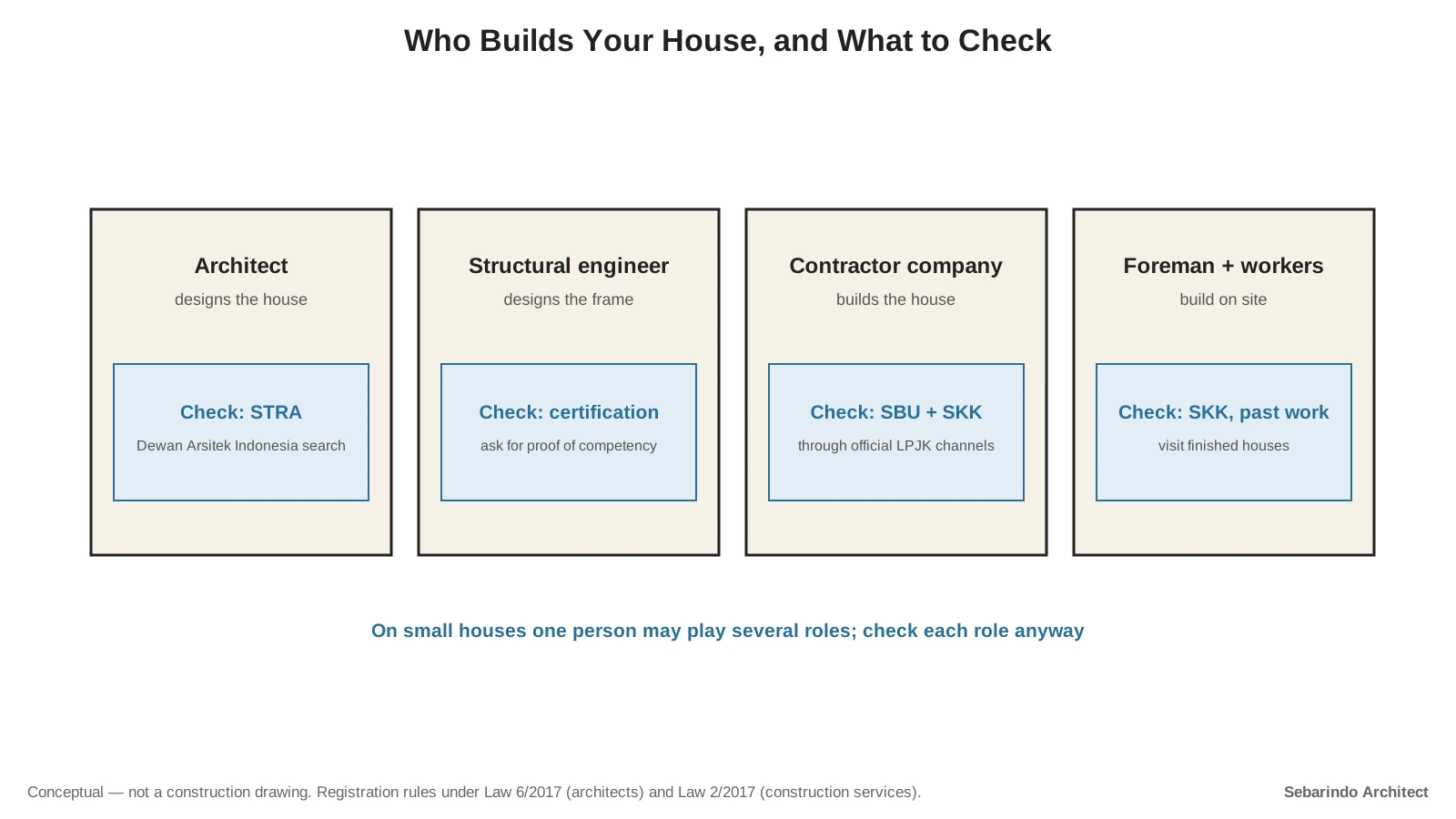
Ask a licensed structural engineer to design the frame, the ties between walls and columns, and any openings. Neither material makes a house safe on its own.
Before You Order
Ask the supplier for the SNI number and class, and for test results if they have them. For bricks from local kilns, check a few pieces for size and edges before you accept a delivery.
Order a little extra to cover breakage, and keep blocks dry and stacked off the ground before use.
This comparison covers walls for one- and two-story houses. Taller buildings and load-bearing masonry follow different design rules, which belong in an engineer’s hands.
This article is general information, not a structural, electrical or legal assessment of your building. Structural work, wiring and permit decisions should be checked by a licensed architect or engineer and your local building office.
Komentar Ditutup! Anda tidak dapat mengirimkan komentar pada artikel ini.